
Most PPF investors focus on two things: how much to invest and where to park the money. Very few pay attention to when to invest. Yet that one small variable, the date of deposit, can quietly add tens of thousands of rupees to your final corpus or silently drain them away, month after month, year after year.
This is not a minor technicality buried in fine print. It is the single most actionable rule in the entire PPF framework. Master it, and your PPF works at full efficiency. Ignore it, and you are essentially leaving guaranteed, tax-free interest on the table every month for 15 years.
Here is everything you need to know.
Table of Contents
What Is the 5th-of-the-Month Rule in PPF?
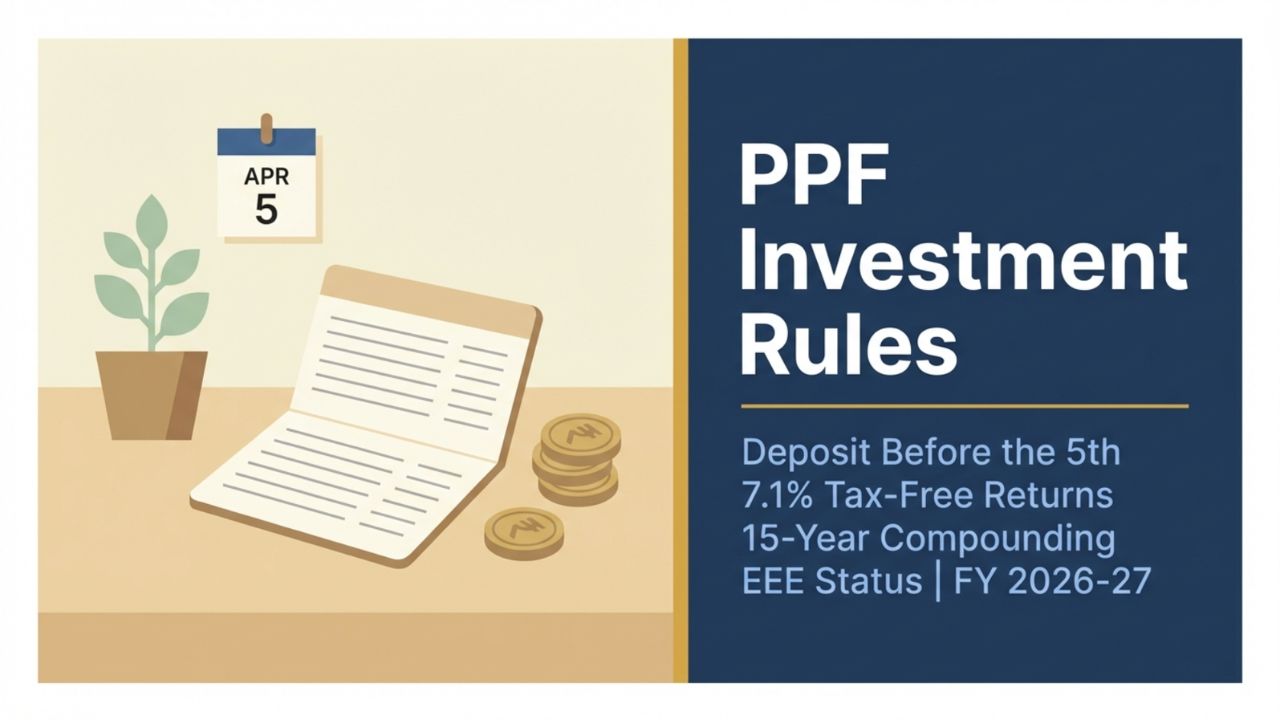
PPF interest is calculated monthly on the lowest balance between the 5th and the last day of the month, even though it is credited only at the end of the financial year.
This means the first five days of every month are a critical window. If you deposit on or before the 5th, your money earns interest for that month. If you deposit after the 5th, your money earns no interest for that month.
The logic is straightforward: the government calculates the “qualifying balance” as the minimum balance in your account between the 5th and the last day of the month. Any money that lands in your account on the 6th or later simply does not exist for that month’s interest calculation. It picks up only from the following month.
Over a single month, the loss seems minor. Over 15 years of compounding, it is anything but.
Why This Rule Matters More Than You Think: The Numbers
If you invest ₹1.5 lakh before April 5th, you earn ₹10,650 in interest for the year. If you invest on April 20th instead, you earn only ₹9,762.50, a loss of ₹887.50 for missing the deadline by just a couple of weeks. And if you wait until March 1, 2027 to invest, you only earn interest for one month: ₹887.50 on the full ₹1.5 lakh.
That ₹887.50 loss in a single year may look trivial on its own. But PPF does not work in isolation, it compounds. The interest earned each year gets added to the principal, and the next year’s interest is calculated on that larger base. Every rupee you lose through late deposits is a rupee that no longer contributes to compounding across the remaining tenure.
Assuming a constant interest rate, investing the maximum ₹1.5 lakh every year before the 5th of the month can add approximately ₹30,000–₹40,000 to your corpus at the end of the 15-year lock-in period compared to consistently depositing late.
That is real money, generated entirely from a habit that costs zero extra rupees. Just better timing.
The April 5th Rule: The Most Important Deposit of the Year
For lump-sum investors, those who put in the full ₹1.5 lakh at the start of the financial year, the April 5th deadline is the single most important date in your PPF calendar.
Depositing your annual amount as a lump sum before April 5th means you earn interest for all 12 months of that year. Depositing on April 6th costs you one full month of interest on the entire amount.
This is not just about the interest for April. It is about the compounding cascade that follows. A deposit made before April 5th earns interest from month one. That interest gets credited on March 31st and added to your balance. The next year, your opening balance is higher, which means the interest slab in Year 2 starts from a larger figure. And so on, for 15 years.
Many investors rush to invest in March just to save taxes. While this helps with deductions under Section 80C, it significantly reduces your interest earnings. A March deposit earns interest for just one month of the financial year, whereas an April deposit, made on time, earns for the full 12 months. Both get you the same Section 80C deduction. Only one maximises your return.
The lesson: do not treat PPF like a last-minute tax-saving exercise. Treat it as a compounding engine, and fuel it early.
PPF Interest Rate for FY 2026-27: What You Need to Know
The government left PPF interest rates unchanged for the eighth consecutive quarter beginning April 1, 2026. The rate remains at 7.1% per annum for Q1 FY 2026-27 (April to June 2026).
The rate is reviewed every quarter, and while it has remained stable recently, it is linked to government bond yields and is ultimately at the government’s discretion.
At 7.1% compounded annually with complete tax exemption, PPF delivers an effective pre-tax equivalent return of approximately 9.8% for someone in the 30% tax bracket, a rate that beats most fixed deposits and debt mutual funds on a post-tax basis. By investing the maximum ₹1.5 lakh annually for 15 years, you earn over ₹18 lakh in tax-free interest.
The EEE Status: Why Tax Efficiency Makes PPF Uniquely Powerful
PPF is one of the very few investment instruments in India that carries full EEE, Exempt-Exempt-Exempt, tax status.
Your deposits qualify for Section 80C deduction up to ₹1.5 lakh per year, the interest earned at the current rate of 7.1% per annum is completely tax-free, and the entire maturity corpus is tax-free on withdrawal.
It is important to note that Section 80C deductions are only available under the Old Tax Regime. If you have moved to the New Tax Regime for FY 2026-27, you will not be able to claim deductions on PPF contributions. However, the interest income and maturity proceeds remain tax-free under both regimes, making PPF’s compounding advantage valuable regardless of which regime you choose.
Two Strategies: Lump Sum vs Monthly Deposits
Not everyone has ₹1.5 lakh available at the start of April. If you are investing in monthly instalments, the 5th-of-the-month rule applies to every single deposit, not just the April one.
Strategy 1: Annual Lump Sum Before April 5th
This is the gold standard for maximising PPF returns. Deposit the full ₹1.5 lakh before April 5th every year. Your entire investment earns interest for all 12 months of the financial year. This strategy requires upfront capital availability but delivers the maximum compounding benefit.
Strategy 2: Monthly Deposits Before the 5th
If investing in instalments, ensure each deposit is made before the 5th of every month. This ensures consistent interest accrual and avoids losing monthly earnings. The monthly limit works out to ₹12,500 if you want to reach the maximum of ₹1.5 lakh in a year. Setting up a standing instruction or auto-debit from your bank account, timed to execute on the 1st or 2nd of every month, removes human error from the equation entirely.
The lump-sum strategy edges out the monthly approach on total interest earned, since the full amount earns for 12 months versus an average of 6–7 months for monthly deposits. But for anyone managing cash flows and salary cycles, the monthly route is perfectly sound, as long as the 5th-of-the-month discipline is maintained.
Key PPF Rules for FY 2026-27: A Quick Reference
Minimum deposit: ₹500 per financial year. Missing even one year deactivates the account, requiring a ₹50 penalty per missed year plus the minimum deposit to reactivate.
Maximum deposit: ₹1.5 lakh per financial year. Any amount above this earns no interest and receives no tax benefit.
Lock-in period: 15 years from the end of the financial year of account opening.
Partial withdrawals: Partial withdrawals are allowed from the 7th year onwards, capped at 50% of the balance at the end of the 4th year or the year preceding withdrawal, whichever is lower.
Loan facility: Available between the 3rd and 6th year, with the maximum loan amount being 25% of the balance at the end of the second preceding year.
Extensions: After the 15-year maturity, you can extend in 5-year blocks, either with fresh contributions or without. Extending without contributions lets the existing corpus continue compounding tax-free with no additional deposits required.
Account opening: PPF accounts can now be opened using Aadhaar-based biometric eKYC authentication, with funds deposited and withdrawn using this paperless facility.
Joint accounts: Not permitted. Each individual can hold only one PPF account. However, parents or guardians can open a separate account in a minor child’s name, though the ₹1.5 lakh annual limit is shared across the parent’s and minor’s accounts.
The Power of the 15-Year Lock-In: What Your Money Actually Becomes
The lock-in period that many investors see as a disadvantage is actually PPF’s greatest feature. It forces the discipline that most investors lack, and it lets compounding do its heaviest lifting undisturbed.
Investing the maximum ₹1.5 lakh every year at 7.1% for 15 years builds a corpus of approximately ₹40.68 lakh. Extending the same investment to 30 years, by continuing deposits for an additional 15 years, can grow the corpus to over ₹1 crore.
The arithmetic is stark. Your total investment across 15 years is ₹22.5 lakh. Your maturity corpus is approximately ₹40.68 lakh. That means ₹18 lakh was generated entirely by interest, and every rupee of that ₹18 lakh is tax-free in your hands.
Extending by even one 5-year block dramatically accelerates this. A person investing ₹1.5 lakh annually before April 1st each year gets approximately ₹40.68 lakh at the 15-year mark. With a 5-year extension continuing contributions, the corpus grows to approximately ₹66.93 lakh. The power of compounding on a larger base makes each successive extension period disproportionately productive.
Practical Tips to Never Miss the 5th Again
Set an auto-debit or standing instruction. Most banks allow you to set up automatic transfers to your PPF account. Schedule it for the 1st or 2nd of every month, this creates a buffer even if a public holiday or weekend delays processing.
For annual investors, mark April 1–4 as your “PPF window.” The new financial year opens on April 1st. Use the first four days to transfer the full ₹1.5 lakh. Do not wait for your March salary to clear, plan your liquidity ahead.
Use internet or mobile banking. Internet banking allows you to deposit money into your PPF account on time each month in just a few clicks, ensuring your funds start earning interest for the full month.
Do not invest only in March to save taxes. This is the single most common and costly mistake PPF investors make. A March deposit saves your tax for that year but earns interest for just one month, a full 11 months of potential compounding is wasted.
Is PPF Still Worth It in 2026?
With equity markets offering higher headline returns and newer investment options multiplying, it is a fair question. The honest answer is: PPF is not for everyone’s entire portfolio, but it remains irreplaceable for a specific purpose.
PPF remains a safe and tax-efficient investment that rewards discipline. For long-term investors, the simple habit of depositing before the 5th can make a real difference to final corpus creation.
For anyone who values capital safety, wants guaranteed government-backed returns, needs a disciplined long-term savings vehicle, and values complete tax exemption on the proceeds, PPF at 7.1% compounded annually with EEE status is difficult to beat on a risk-adjusted, post-tax basis. It will not make you rich overnight. But it will quietly, reliably build a meaningful corpus over 15–30 years, completely free of tax at the other end.
The only condition: respect the 5th-of-the-month rule. Always.