
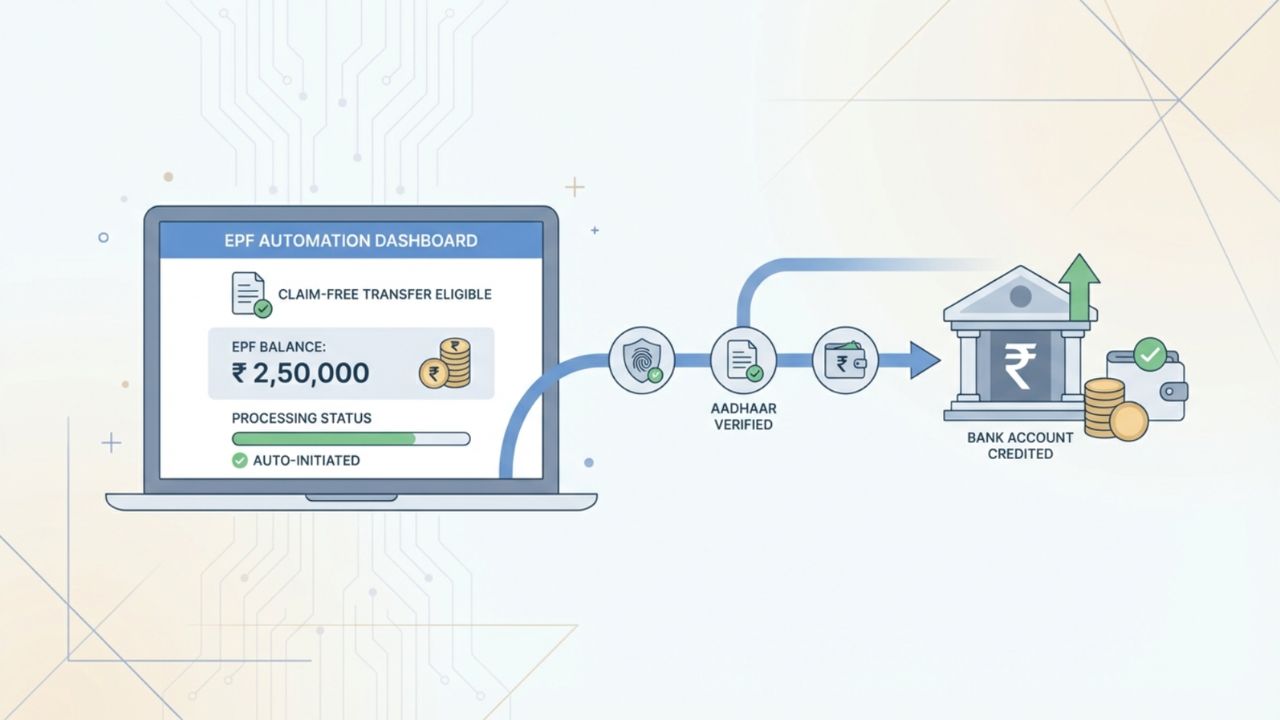
A fresh wave of interest around EPFO’s “auto transfer” or “no-claim” payout rule has come after new reports suggested that dormant EPF money could start moving directly into members’ bank accounts. The topic matters because millions of workers change jobs, forget older PF accounts, or end up with balances spread across multiple member IDs over time. The latest official material does show a real shift toward automation, but the rule is narrower than some headlines make it sound.
The most important update is this: EPFO’s Central Board approved a pilot project for auto-initiation of claim settlement in inoperative accounts with unclaimed balances of Rs 1,000 or less. In the first phase, around 1.33 lakh such accounts with nearly Rs 5.68 crore are to be covered, and the money is to be credited directly into Aadhaar-seeded, EPFO-linked bank accounts without fresh claims or documentation. That is the clearest current official position.
At the same time, EPFO already has a separate auto-transfer mechanism for job changers. When a member has a seeded UAN and complete KYC, the system can auto-trigger transfer of past PF balance to the new account after the first contribution from the new employer is received. So, there are really two different ideas here: automatic PF transfer on job change, and limited automatic bank credit for small inoperative balances. Understanding that difference is the key to getting this story right.
Table of Contents
What the Official EPFO Update Actually Says
The strongest official announcement came from the Ministry of Labour and Employment in March 2026. It said the Board approved a pilot project for auto-initiation of claim settlement in inoperative EPFO accounts with balances of Rs 1,000 or less. The same release said the money would be credited straight to members’ Aadhaar-seeded and EPFO-linked bank accounts without requiring fresh paperwork. That means the reform is real, but officially it is still framed as a pilot and is currently tied to small balances only.
This matters because some media write-ups create the impression that all dormant EPF balances can now be pushed directly into bank accounts with no member action. The official record does not support that broader reading yet. As of the latest government announcement, the no-fresh-claim route is specifically tied to the approved pilot for small inoperative balances, not to all dormant EPF money across the board
Dormant, Inoperative, and Auto-Transfer Are Not the Same Thing
In ordinary conversation, people often use words like dormant, inactive, forgotten, and unclaimed interchangeably. EPFO’s own terminology is stricter. A 2024 Parliament reply said there are no “unclaimed accounts” in EPF in the legal sense; instead, certain accounts are classified as inoperative, and all such accounts still have definite claimants. The same reply said EPFO had settled Rs 7,576 crore of claims against inoperative accounts in the previous three years.
EPFO’s current FAQ also clarifies when an account becomes inoperative. It says an employee’s EPF account becomes inoperative after 36 months from the date of retirement on or after attaining age 55, and once it becomes inoperative it stops earning further interest. The FAQ adds practical examples: if a member retires at 50, interest can continue until age 58, while someone retiring at 60 would keep earning interest up to 63.
That distinction is important for readers because an old PF account after a job switch is not automatically the same as an inoperative retirement-stage account. If a member has joined another EPF-covered establishment, EPFO’s system generally expects transfer into the current account rather than direct bank withdrawal. That is why many people who search for “dormant PF payout” are actually dealing with a transfer issue, not a retirement-stage settlement issue.
The Real Opportunity for Members Right Now
For a worker wondering whether money can arrive directly in the bank without filing a fresh claim, the short answer is yes, but only in limited official circumstances right now. The March 2026 Board-approved pilot covers inoperative EPFO accounts with balances of Rs 1,000 or less, and the first phase targets roughly 1.33 lakh accounts with around Rs 5.68 crore in total. The money is meant to move directly into the linked bank account if the account is Aadhaar-seeded and properly connected with EPFO records.
That is different from a normal final withdrawal claim. EPFO’s online-claim FAQ says regular online final settlement still requires an activated UAN, Aadhaar linked in EPFO records, bank account with IFSC seeded, and PAN for final settlement claims where service is less than five years. It also says the member should not be currently working in an EPF-covered establishment, and the claim should not be submitted before two months from leaving service in eligible resignation cases.
So the emerging picture is clear: EPFO is expanding automation, but most members still need either a transfer claim, an online withdrawal claim, or an unblocking/correction step if their records are incomplete. The pilot reduces friction for a narrow set of small inoperative balances, not for every old PF amount people may have lying around.
How Auto Transfer Works When You Change Jobs
EPFO has long been moving toward portability under the UAN system. Its official transfer FAQ says UAN acts as an umbrella for multiple member IDs and supports auto-triggering of transfer requests on change of employment. The same FAQ states that when a member’s UAN is seeded and fully KYC-compliant, the member should not file a transfer claim after changing jobs; once the first PF contribution from the new employer is received, the system can generate an auto-transfer trigger and move the past PF amount into the new account unless the member stops it.
EPFO’s 2017 circular gives more detail. It says auto-transfer can be marked when Aadhaar is seeded and verified at the previous establishment level, previous-employment details such as date of joining, date of exit and reason of exit are available, and the UAN is activated with a mobile number. The circular also says members can request EPFO to stop an auto-initiated transfer within 10 days of receiving the SMS, using the “Track Claim Status” and “Stop Auto Initiated Claim Cases” functionality or by approaching the employer or EPFO office.
This job-change auto-transfer system has also been expanded recently. A January 2025 PIB release said that in most cases the need to route online transfer claims through the previous or present employer was removed, and it projected that more than 1.20 crore out of 1.30 crore total transfer claims, about 94%, would eventually go directly to EPFO without employer intervention. The same release said that from 1 April 2024 until then, about 45 lakh of 1.30 crore online transfer claims were auto-generated transfer claims, or 34.5% of the total.
A further April 2025 EPFO press release said its revamped Form 13 functionality removed destination-office approval, allowing transfer from the previous account to the present account instantly once approved at the source office. EPFO said this could benefit more than 1.25 crore members and speed transfer of around Rs 90,000 crore every year. That shows the broader direction of policy: EPFO is steadily trying to make PF movement more automatic, but it is doing so in separate layers depending on the case type.
What Members Should Check Before Expecting Any Automatic Credit
The biggest practical lesson for members is that data quality decides everything. EPFO’s official FAQs say online claim and transfer services depend on an activated UAN, Aadhaar seeded in EPFO records, and bank details properly seeded. EPFO also says a member can update bank details through the member portal, but the change is then approved by the employer. If the registered bank account is wrong or closed, payment will not simply go to another account by choice during online claim submission.
Exit details are another common blocker. EPFO’s transfer FAQ says date of exit for previous employment is mandatory for online transfer, and it can be updated only after two months of leaving the job. The same FAQ explains that members can use the “Manage” and “Mark Exit” option in the portal to update date and reason of exit through Aadhaar-based OTP authentication, and once updated, that exit date cannot be changed casually.
Multiple UANs can also complicate matters. EPFO’s transfer FAQ says if a member has two different UANs with different member IDs linked to them, there is no online transfer-claim provision in that situation and a physical Form 13 route may be required. That is one reason many members believe their money is “stuck” when the actual issue is duplicate identity mapping rather than non-release of funds.
A Simple Way to Read the Rule
For readers trying to understand their own case, the easiest framework is this:
| Situation | What EPFO system generally expects |
|---|---|
| You changed jobs and your UAN, Aadhaar, exit details, and KYC are clean | Past PF may auto-trigger for transfer to the new PF account after first contribution from the new employer |
| You have an inoperative EPFO account with Rs 1,000 or less and clean bank/Aadhaar linkage | You may fall under the Board-approved pilot for direct bank credit without fresh claim/documentation |
| You have an inoperative account but the UAN is linked to another live PF account | EPFO’s SOP says transfer claim is the route, not final withdrawal |
| You have an inoperative account and no other active PF account | After unblocking and verification, final withdrawal may be possible under the normal claim path |
| Your records have mismatched name, DOB, Aadhaar, bank, or exit details | Automation can fail until corrections are completed through EPFO processes |
Why This Reform Still Matters
Even with its current limits, this pilot is significant. Parliament data showed 21,55,387 inoperative EPF accounts as of 31 March 2024, with Rs 8,505.23 crore held in such accounts. When the system starts auto-clearing even the smallest balances, it reduces friction, cleans up legacy records, and could become a testing ground for broader automation later if the pilot works well.
The wider policy direction also supports that reading. EPFO has been simplifying transfer claims, reducing employer approvals, expanding auto-generated transfers, and increasing auto-settlement in other categories of claims as part of a broader digital push. So while members should not assume every dormant PF balance will now land in the bank automatically, they should recognize that EPFO is clearly moving toward faster and more automated settlement architecture.
Final Take
The headline promise is partly true but needs careful qualification. Yes, EPFO has approved a mechanism under which some inoperative balances can move directly into members’ bank accounts without a fresh claim. But the current official version is a pilot limited to inoperative accounts of Rs 1,000 or less, with payment routed only to Aadhaar-seeded and EPFO-linked bank accounts. For most other members, the path still depends on whether the issue is a job-change transfer, an inoperative-account unblocking case, or a normal final withdrawal claim.
That means the smartest move for EPF subscribers today is not to wait blindly for automation. It is to make sure the UAN is active, Aadhaar and bank KYC are correctly seeded, exit details are accurate, and duplicate UAN issues are resolved. Members who do that are the ones most likely to benefit first as EPFO widens automated processing in the months ahead.