
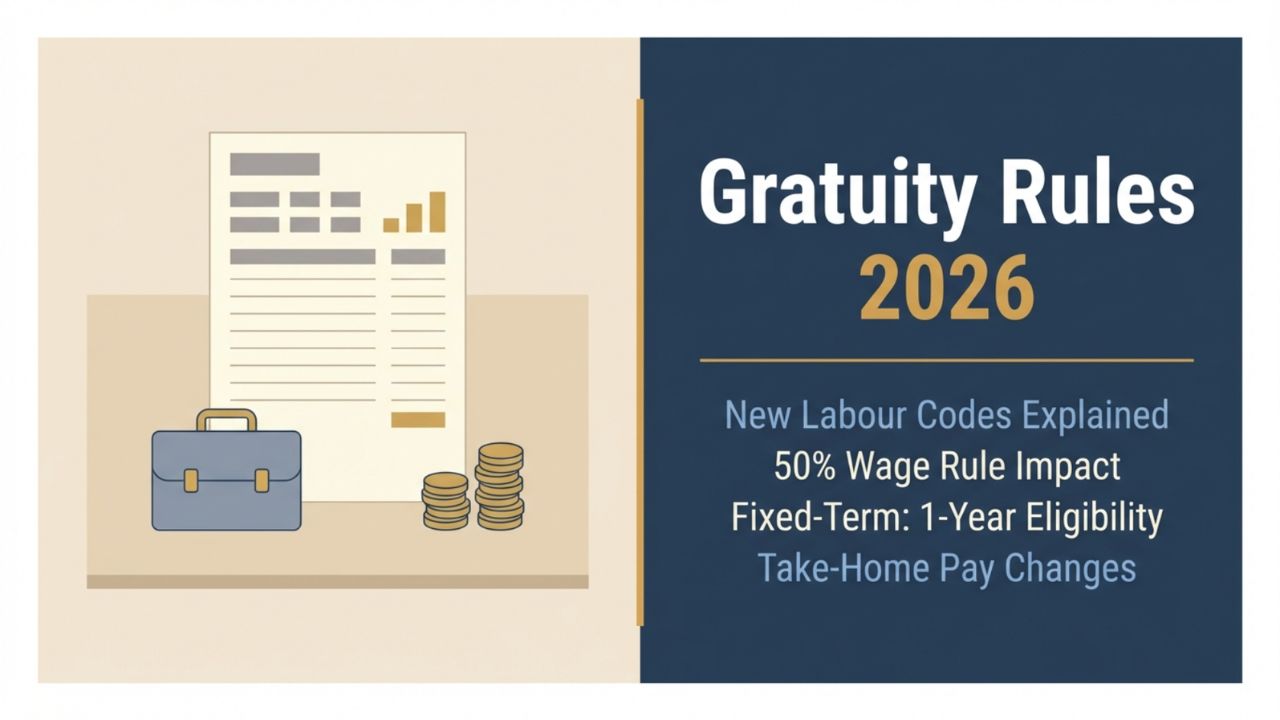
If you are a salaried employee in India, the word “gratuity” has probably only crossed your mind when a colleague retired or resigned after years of service. That casual attitude is about to become expensive. India’s four new Labour Codes, notified on November 21, 2025, and gathering implementation momentum as the new financial year begins on April 1, 2026, have fundamentally restructured the gratuity framework.
The changes touch three things that matter most to every working Indian: who qualifies, how much they get, and what it does to their monthly take-home pay. This guide cuts through the legal jargon and gives you the full picture.
Table of Contents
What Has Actually Changed? The Three Core Shifts
1. The 50% Wage Rule: The Most Consequential Change
This is the engine driving everything else. The four Labour Codes propose structural changes rooted in a simple rule: at least 50% of an employee’s total Cost to Company (CTC) must be classified as “wages,” which includes basic pay and dearness allowance.
Why does this matter? For years, Indian companies exploited a loophole. By keeping basic salary artificially low, sometimes as little as 30–40% of CTC, and padding the rest with allowances like special allowance, conveyance, and HRA, they reduced their statutory obligations for PF and gratuity. The labour codes have mandated that 50% of the total remuneration must be considered as wages for calculating statutory benefits. To date, many employers have considered only 30–40% of compensation as wages for this purpose.
Under the new framework, allowances that are excluded from wages, such as HRA, conveyance, employer PF contribution, or commissions, cannot together exceed 50% of total remuneration. If they do, the excess must be added back into wages for statutory benefit calculations.
In plain terms: if your CTC is ₹1 lakh per month and your employer currently designates ₹70,000 as allowances and only ₹30,000 as basic, that structure is no longer compliant. The excess ₹20,000 in allowances gets reclassified as wages, and your gratuity and PF both get calculated on the higher base.
2. Fixed-Term Employees: Gratuity After 1 Year, Not 5
This is the most socially significant change in the new framework. Fixed-term employees are now eligible for gratuity after just 1 year of continuous service, instead of the earlier requirement of 5 years. Permanent employees continue to require 5 years of continuous service.
Rohit Jain, managing partner at Singhania & Co, clarifies: “The reports that every employee will now get gratuity after one year are incorrect. It is still five years for permanent employees. Only fixed-term employees benefit from the new one-year rule.”
This distinction matters enormously in a labour market where short-term contracts, project-based hiring, and fixed-term employment have become common, particularly in IT services, manufacturing, and the media industry. For working journalists, the code proposes an eligibility period of three years instead of five, keeping in mind the nature of employment in media, where shorter tenures are common.
3. Broader Wage Definition Increases the Calculation Base
Even for permanent employees who already had 5 years of service, the gratuity they receive at exit will be higher under the new rules, simply because the wage base used for calculation is wider.
As per the uniform definition under the new labour codes, “wages” include basic pay, dearness allowance, and retaining allowance. Overtime, bonus, commission, HRA, and certain other allowances are excluded. Crucially, this broader base often results in a significantly higher figure than what employers previously used.
How Gratuity Is Calculated: The Formula and What Changes
The core gratuity formula remains unchanged:
Gratuity = (Last Drawn Wages × 15 × Number of Completed Years of Service) ÷ 26
What has changed is the definition of “Last Drawn Wages.” Previously, many companies used only basic salary for this calculation. Now, wages must represent at least 50% of CTC, making the base higher for most employees.
The number 15 represents 15 days’ wages (half a month’s salary), and 26 accounts for the average number of working days in a month, excluding Sundays.
Service year rounding rule: A period of more than six months is considered as one full year. The maximum gratuity amount is capped at ₹20 lakh.
Worked Example, Before vs After the New Rules
Consider an employee with 8 years of service whose CTC is ₹3 lakh per month (₹36 lakh annually):
Under the old structure, if basic salary was set at ₹90,000 per month (30% of CTC): Gratuity = (₹90,000 × 15 × 8) ÷ 26 = ₹4,15,385
Under the new structure, with wages mandated at 50% of CTC, ₹1,50,000 per month: Gratuity = (₹1,50,000 × 15 × 8) ÷ 26 = ₹6,92,308
For an employee with 8 years of service, restructuring basic pay upward in line with the 50% rule directly and significantly increases the final gratuity payout. In the example above, the difference exceeds ₹2.75 lakh, purely from a redefinition of the wage base, not from any increase in CTC.
The Real-World Example: How the Wage Reclassification Works
Consider a permanent employee with a basic salary of ₹1,00,000 per month, which is just 38.91% of a total monthly CTC of ₹2,57,000. Under the old rules, the salary for gratuity purposes was ₹1,00,000. Under the new code, because the excluded allowances exceed 50% of CTC, the excess must be added back into wages, bringing the salary for gratuity purposes to ₹1,17,300.
That is a meaningful jump in the calculation base, and it applies to every year of service. Over a 10-year tenure, the compounding effect on the final payout is substantial.
Impact on Take-Home Pay: The Trade-Off You Need to Understand
Here is the headline that has been making employees anxious: the new rules will likely reduce your monthly take-home salary. But the full picture is more nuanced than the headline suggests.
The most immediate and noticeable impact for employees will be a dip in net take-home pay. This happens because a higher basic wage means higher PF deductions from both employee and employer, while total CTC may remain the same. This is not a pay cut. It is a redistribution from present income to future security.
Here is the mechanism: If your basic salary rises from ₹30,000 to ₹50,000, your PF contribution jumps from ₹3,600 to ₹6,000 per month, and your employer adds the same. Over a 20–25 year career, this difference can translate into a substantial financial cushion.
The likely take-home salary dip is 2–5% for employees whose basic was below 50% of CTC. Employers may offset this via CTC hikes.
Critically, a lower in-hand salary is possible, but not automatic. A higher wage base means higher statutory contributions. If the employer passes the entire burden to the employee without increasing gross pay, take-home salary will reduce. But companies may also restructure allowances to soften the impact.
The employee-friendly angle: your PF corpus grows faster, your gratuity at exit is higher, and your pension base is stronger. The short-term squeeze is real; so is the long-term gain.
Who Is Eligible for Gratuity? The Complete Breakdown
Permanent employees: Eligible after completing 5 years of continuous service, payable on superannuation, resignation, retirement, or termination.
Fixed-term employees: Eligible for gratuity on a pro-rata basis after completing 1 year of continuous service from the start of the contract. This change is effective from November 21, 2025.
Death or disablement: Gratuity is payable regardless of service duration if an employee dies while in service or is disabled due to accident or disease. The five-year rule does not apply in these cases, gratuity is paid to the nominee or legal heir.
The 4 years and 240 days rule: This is a nuanced interpretation that some courts and employers apply, where an employee who has completed 4 years and approximately 8 months may be considered to have fulfilled the “5 year” requirement. However, the safest interpretation remains 5 full years of continuous service for the purpose of certainty.
Tax-exempt limits:
- Private sector employees: Gratuity up to ₹20 lakh is fully tax-exempt (lifetime limit across all employers).
- Central government employees: Tax-exempt up to ₹25 lakh.
- Interest earned due to delayed payment beyond 30 days is taxable.
What the New Rules Mean for Employers
The compliance burden on employers is real and immediate. Since gratuity will be payable on at least 50% of the total remuneration paid to an employee, in cases where the base for determining salary was lesser, say 40% of CTC, employers will see an increase in the liability on account of gratuity payouts.
For most Indian companies, the new rules are expected to increase gratuity liabilities by 25–50%, as the wage base expands and previously excluded employees become eligible earlier.
Companies are also required to settle gratuity dues within 30 days of the date it becomes payable. Delayed payments attract interest, making timely payroll compliance non-negotiable.
One important clarification: gratuity is non-contributory, it cannot be deducted as a separate monthly recovery from the employee. At most, some employers may redesign salary structures prospectively to manage overall CTC, but that is a compensation design issue, not a lawful gratuity deduction from take-home pay.
Common Misconceptions: Cleared
“Everyone gets gratuity after 1 year now.” False. The 1-year rule applies only to fixed-term contract employees. Permanent employees still need 5 years of continuous service.
“My take-home will definitely drop.” Not necessarily. It depends entirely on how your employer restructures the CTC. If the employer absorbs the additional PF cost, your take-home stays the same. If it is passed on, it reduces. The structure varies by company.
“Gratuity is part of my CTC, so I’m already covered.” While many companies show an estimated gratuity cost inside CTC, legally that does not change its nature, it is a statutory benefit, not a salary component. Employers may or may not include it in CTC, but it remains a mandatory obligation regardless.
“These rules are retrospective, my employer owes me back pay.” No. Employers are not required to recover any shortfall in PF or gratuity contributions from past years. The new provisions apply prospectively from November 21, 2025.
Is the New Framework Good or Bad for Employees?
The honest answer: it depends on your time horizon.
For employees in the early-to-mid career phase whose salary structures have kept basic pay artificially low, the new framework is unambiguously better in the long run. Higher PF contributions mean a larger retirement corpus. A broader wage base means a higher gratuity at exit. The cost is a modest, near-term reduction in in-hand salary, typically ₹1,000–₹3,000 per month for mid-income earners, depending on the restructuring.
For fixed-term employees, the most underserved category in India’s formal workforce, the 1-year eligibility rule is a landmark shift. Workers on 2- or 3-year contracts who previously received no gratuity whatsoever now have a statutory claim to it.
The shift clearly prioritises long-term wealth creation over short-term liquidity. While the headline impact feels immediate, the deeper story is about stronger retirement savings, better social security, and a more standardised wage structure across industries.
The one genuine concern is for employees who resign before 5 years, they receive no gratuity regardless of the new wage definition. For this group, the higher PF deductions arrive without the corresponding gratuity benefit at exit. Understanding your employment category and tenure timeline has never mattered more.
Action Steps for Salaried Employees
Check your current salary structure. Ask your HR department what percentage of your CTC is designated as “wages” (basic + DA). If it is below 50%, restructuring is imminent.
Understand your employment type. Are you on a permanent contract or a fixed-term contract? Your eligibility timeline is fundamentally different under the new rules.
Recalculate your expected gratuity. Use the formula: (New Wage Base × 15 × Years of Service) ÷ 26. Compare it to what you would have received under the old structure.
If your take-home reduces, do not panic. Track where the money goes, most of it flows into PF, building a retirement corpus that belongs entirely to you.
Ask your employer about the restructuring timeline. Implementation depends on state-level notifications, and as of March 2026, the process is underway state by state. Once officially notified in your state, compliance becomes immediately mandatory with no grace period.